Tuesday, January 31, 2006

Chordpack

I created a GUI-less Perl program Chordpack for typesetting of songs with guitar chords using program for creation of electronic documents LaTeX. Chordpack is hosted at Google sites (Blogger does not allow file attachments, I think). I would not write it in Perl programming language any more. Chordpack is for technically minded users; users of Chordpack do not shy away from such tedious tasks as installing LaTeX on their computers.

Download:

License:

  • GNU GPL V2+

Version history (can be retreived from Wayback Machine): 

  • Chordpack 0.7.9, 6 June 2001 (inferred from Wayback Machine).
  • Chordpack 0.8.1, 23 July 2001 (inferred from Wayback Machine).
  • Chordpack 0.8.2, main file date 14 Oct 2009, but documentation date 18 Nov 2003, which seems more plausible as the date of significant change

Related links:

License of this post: CC-BY-SA 4.0 International; last update: 6 Aug 2026; first published: 31 Jan 2006.

Labels:

Alfred - Model Checker

(Read further only if you are a theoretical computer scientist.) I have implemented model checker Alfred as part of my master thesis. The model checker decides the validity of formulas of alternation free modal mu-calculus for push down systems, and push down automata. The model checker implements the algorithm described in article Reachability Analysis of Pushdown Automata: Application to Model-Checking. Modal Mu-calculus is a temporal logic with fixed point operators, of branching time, as opposed to a linear-time logic like LTL.

For a pdf file with the text of the master thesis and for the source code of the model checker, see http://sites.google.com/site/danpolansky/alfred. See also Model checking at Wikipedia.

Labels:

Monday, July 11, 2005

Some notes on using MediaWiki

What follows are personal notes on using MediaWiki, originally from 2005, and not much was changed. I must have created them in relation to our using MediaWiki for FreeMind website, which we still do in 2025. MediaWiki is really nice for the purpose, by my assessment. FreeMind project started to use MediaWiki on 10 Sep 2004‎[0].

Backing up content

To back up content of MediaWiki, run the following [1].
php maintenance\dumpBackup.php --full > full.xml
Alternatively, run mysqldump as follows [2].
mysqldump -u user -p password -B wiki-database-name > wikidb.sql

(2025) One could also use the Special:Export function to export the latest revisions or full history into an XML file; one has to provide a list of pages to be backed up/exported in this way.

Installing MediaWiki on SourceForge

See one of the following links.

More external links

Last update: 20 Dec. 2025. 

Labels:

Friday, June 03, 2005

What e-mail name conventions are used

This is a small overview of what e-mail name patterns I have encountered and which I find preferable. Let us assume that my name is Thomas Kuhn and my postal address is structure.com.

The most prevalent pattern or convention is thomas.kuhn@structure.com, this is my favorite. Other patters are tkuhn@structure.com and ThomasKuhn@structure.com. Also, note that Thomas.Kuhn@structure.com is not really different from the first one, because capital letters do not matter in e-mail names.

Another option would be tom.kuhn@structure.com.

Labels:

SourceForge is highly helpful in developing free applications

SourceForge is a web site for managing open source application. What strikes me most about it is the transparency it brings including the statistics. You can see how many downloads and page views the project has and had, together with all the history of activity, that all compared to other projects. You can see what kind of applications are found useful by users, and you can estimate the cash contribution your project is making on the global scale, thus controlling at least a bit if the activity of development is economical in terms of value.

Unlike commercial projects, free projects have hard time measuring the contribution and efficiency of consumed resources like time and concentration of their developers. Some economic mathematical model should be developed to enable estimation of contribution of such projects, provided that their developers want to create value rather than just have a good time, the two not being necessarily at cross-purposes.

Labels:

Saturday, January 29, 2005

Duenix - game for Amiga computers

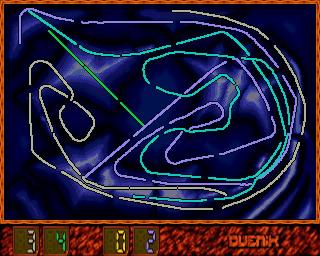
In years 1994-1998, I have created a multiplayer game Duenix for Amiga computers, featuring six worms drawing lines with holes, and trying to kill each other. The web page of the game including screenshots follows.

Download

Get from Aminet the following.

Hardware requirements

Duenix runs on a plain Amiga 1200, and should work on Amiga 500 too. To run Duenix from diskette, copy the contents of archive Duenix.Lha to an empty diskette, and boot from the diskette.

Copy conditions

Duenix is free. Though, you are asked for a donation. A donation is not required.

Game description

From 2 to 6 players drive their worms on the gameplan, each trying to survive longer then the others. A worm dies when it hits the curve drawn by another player. When there is only one player left, a round is finished. The curve drawn by the worms contains spaces so that longer game is possible.

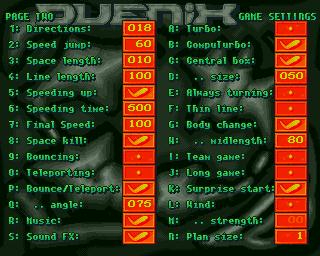
There are lots of great options like bouncing from borders, teleporting, wind, scrolling screen and many others.

Most important features

  • Computer driven players: Any number of players may be driven.
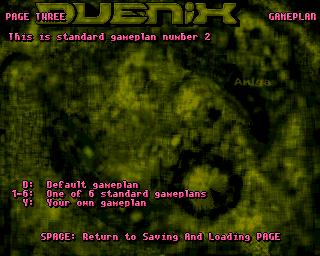
  • Different playing backgrounds (7 predefined, other may be imported)
  • Body exchange: After some period players randomly exchange their bodies. As a result, strategy of cutting as much space for a worm as possible and then driving in that isolated area does not win any more. If there is an opponent alive, no one is sure he will not appear in opponent's situation at next moment. This feature encourages attack.
  • Nice graphics, though not professional (it is OCS graphics)
  • Each player has different number of lives. This allows setting game fair for players with different skills. This feature is especially good in combination with computer driven worms.

Screenshots


External links

Labels: